

This example applies Gotten, a generic model-driven engineering framework for metamorphic testing, to cloud and data centre simulators.
Running example for cloud simulators
The aim is to test cloud simulators that reproduce the behaviour of data centres under a given workload. The simulator inputs are therefore a data centre model and a workload model.
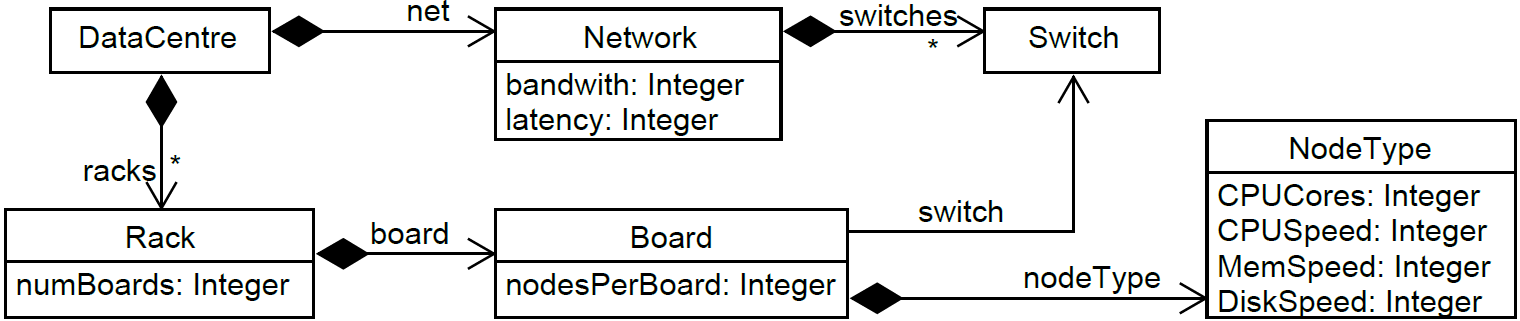
The following figure presents the meta-model used to represent data centres. A DataCentre contains a Network and any number of Racks. Each rack contains several Boards, which are connected through Switches. The boards also contain computing nodes whose characteristics are defined by NodeTypes.
mrDSL program for data centres
Because it is difficult to define a conventional test oracle that determines whether a data centre simulator behaves correctly, this example uses metamorphic testing. The following listing shows the mrDSL program used to apply Gotten to the cloud simulator domain.
metamodel datacentre "/sample.gotten/model/datac.ecore" with m1, m2
models "/sample.gotten/model/dcmodels"
metamodel workload "/sample.gotten/model/workload.ecore" with w1, w2
models "/sample.gotten/model/workloads"

datacentre input Features {
	context DataCentre def: NNodes: Int = racks->collect(numBoards*board.nodesPerBoard)->sum()
	context DataCentre def: CPU: Int = racks->collect(numBoards*board.nodesPerBoard*board.nodeType.CPUCores*board.nodeType.CPUSpeed)->sum()
	context DataCentre def: NMachines: Int = racks->collect(numBoards*board.nodesPerBoard*board.nodeType.CPUCores)->sum()
	context DataCentre def: Storage: Int = racks->collect(numBoards*board.nodesPerBoard*board.nodeType.DiskSpeed)->sum()
	context DataCentre def: Network: Int = net->collect(bandwidth)->sum()
	context DataCentre def: Memory: Int = racks->collect(numBoards*board.nodesPerBoard*board.nodeType.MEMSpeed)->sum()
}

workload input Features {
 	context WorkloadSet def: Workload: Set = workloads->collect(Traces)
 }

output Features {
	Time : Long
	Energy : Long
}
Processor {
	Name: String
	Version: String
}
MetamorphicRelations {
	MR1 = [(( CPU(m1) > CPU(m2) ) and ((w1) == (w2)) ) implies ((Energy(m1) <= Energy(m2)))]
	MR2 = [(( NMachines(m1) > NMachines(m2)) and ((w1) == (w2)) ) implies ((NMachines(m1)/NMachines(m2)) >= (Energy(m1)/Energy(m2)))]
	MR3 = [(( Storage(m1) > Storage(m2)) and ((w1) == (w2)) ) implies (Time(m1) <= Time(m2))]
	MR4 = [(( Network(m1) > Network(m2)) and ((w1) == (w2)) ) implies (Time(m1) <= Time(m2))]
	MR5 = [(( Memory(m1) > Memory(m2)) and ((w1) == (w2)) ) implies (Time(m1) < Time(m2))]
	MR6 = [( ((m1) == (m2)) and ( Workload(w1)->includes(Workload(w2))) ) implies (Time(m2) <= Time(m1))]
}
Brief description of the metamorphic relations
The following table summarises the six metamorphic relations defined for the cloud simulator example.
| Relation | Description |
|---|---|
| MR1 | Data centre model m1 has greater CPU capacity than m2, while workloads w1 and w2 are identical. |
| MR1i = [( CPU(m1) > CPU(m2) ) and ((w1) == (w2)) ] | |
The energy required to execute w1 on m1 should be less than or equal to that required to execute w2 on m2. |
|
| MR1o = [ (Energy(m1) <= Energy(m2))] | |
| MR2 | Data centre model m1 contains more physical machines than m2, while workloads w1 and w2 are identical. |
| MR2i = [( NMachines(m1) > NMachines(m2)) and ((w1) == (w2)) ] | |
The ratio between the numbers of machines in m1 and m2 should be greater than or equal to the corresponding ratio between their energy consumption values. |
|
| MR2o = [ (NMachines(m1)/NMachines(m2)) >= (Energy(m1)/Energy(m2))] | |
| MR3 | Data centre model m1 has a faster storage system than m2, while workloads w1 and w2 are identical. |
| MR3i = [( Storage(m1) > Storage(m2)) and ((w1) == (w2)) ] | |
The execution time of w1 on m1 should be less than or equal to that of w2 on m2. |
|
| MR3o = [ (Time(m1) <= Time(m2)) ] | |
| MR4 | Data centre model m1 has a faster network than m2, while workloads w1 and w2 are identical. |
| MR4i = [( Network(m1) > Network(m2)) and ((w1) == (w2)) ] | |
The execution time of w1 on m1 should be less than or equal to that of w2 on m2. |
|
| MR4o = [ (Time(m1) <= Time(m2)) ] | |
| MR5 | Data centre model m1 has faster memory than m2, while workloads w1 and w2 are identical. |
| MR5i = [( Memory(m1) > Memory(m2)) and ((w1) == (w2)) ) | |
The execution time of w1 on m1 should be less than or equal to that of w2 on m2. |
|
| MR5o = [ (Time(m1) <= Time(m2)) ] | |
| MR6 | Data centre models m1 and m2 are identical, and workload w1 contains workload w2. |
| MR6i = [ ((m1) == (m2)) and ( Workload(w1)->includes(Workload(w2))) ] | |
The time required to execute w2 on m2 should be less than or equal to the time required to execute w1 on m1. |
|
| MR6o = [ (Time(m2) <= Time(m1)) ] |
Download the cloud projects
Acknowledgements
This work was funded by the Spanish Ministry of Science through project MASSIVE (RTI2018-095255-B-I00) and by the Madrid R&D programme through project FORTE (P2018/TCS-4314).